二次开发-数据环境-改变废弃规则
防止重复
先决条件:您必须熟悉教程中使用的语法 并且已经创建了一个扩展.
学习:配置唯一性规则
水平:[ ttps://]初学者
域:[ ttps://]XML, [ ttps://]Constrain, [ ttps://]Dictionary
最低版本:2.6.0
通过定制化iTop,可以在类和唯一性规则上指定规则,以防止重复输入。
在此教程中,我们将看到:
- 从用户角度看唯一性规则的行为
- 如何定义新的唯一性规则
- 开箱即用的iTop中在Person类上定义的唯一性规则
- 删除现有的唯一性规则
行为
- 规则将指定必须在其上检查唯一性的对象的范围。例如,您不希望两个人拥有相同的员工编号,除非该编号为空。那么范围将是每个employee_number不为空的人。
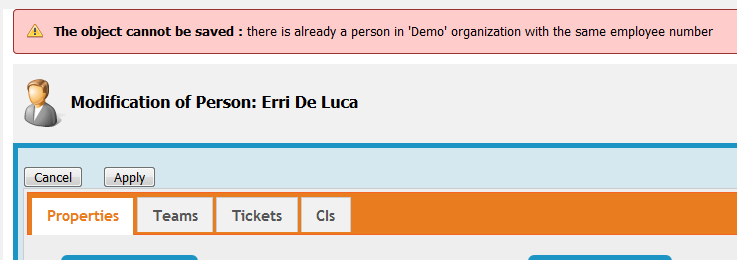
- 在控制台或门户上进行单个创建或修改的过程中,规则可以
- 阻止对象的创建
- 阻止对象的创建
- 或在创建更新后仅显示警告消息。
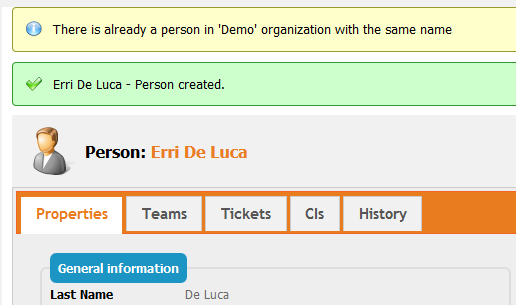
- 唯一性规则适用于该类的一个或多个字段(包括ExternalFields)
- 不支持属性类型的唯一性,例如File, Image, Dashboard, Stopwatch,…(不完整的列表)。
如果您想为组织和员工编号上的人员使用唯一性规则,但是该规则仅适用于您的公司,则将规则的范围定义为“组织XXX的唯一人员”。
在标准数据模型中,我们添加了以下规则:
- Class Brand, id=name, field name,必须是唯一的。
- Class Model, id=name_brand, fields: name + brand_id 必须是唯一的。
- Class Person, id=employee_number fields: org_id + employee_number仅在定义了employee_id的情况下必须是唯一的。
- Class Person, id=name, fields: org_id + first_name + name应该是唯一的(仅警告)。
定义自己的规则
对于定义唯一性规则,我们只需要编写XML。
子类中的唯一名称
在此用例中,仅当它们都属于同一子类时,我们才希望防止它们与另一个FunctionalCI具有相同的名称。例如,NetworkDevice和服务器可以具有相同的名称,但是两个服务器不能具有相同的名称。
<uniqueness_rules> <rule id="functionalci_name" _delta="define"> <!-- field or combination of "FunctionalCI" fields which must be unique --> <attributes> <attribute id="name"/> <attribute id="finalclass"/> </attributes> <!-- ... --> [ ttps://]itop-design / dictionaries / dictionary@EN US / entries <entry id="Class:FunctionalCI/UniquenessRule:functionalci_name"> <![CDATA[there is already a '$this->finalclass$' with the same name]]> </entry>
注意在错误消息中使用占位符'$ this-> finalclass $'
这也可以作为每个子类上的单独唯一性规则来完成,但这需要更多工作。
仅供参考:finalclass是一个神奇的属性,仅存在于抽象类或具有除cmdbAbstractObject或DBObject之外的父的类上。
在此用例中,我们要防止两个FunctionalCI具有相同的名称。除非FunctionalCI实际上是SoftwareInstance,
MiddlewareInstance,DatabaseSchema或ApplicationSolution,在这种情况下,我们不在乎。
假设我们的iTop中只有两个FunctionalCI:
- 一个名为“ bodo.com”的NetworkDevice
- 和一个名为“ iTop”的ApplicationSolution
我们可以做和不能做的:
- 此规则将阻止创建名为“ bodo.com”的服务器,因为已经存在具有相同名称的NetworkDevice
- 这将防止将服务器重命名为“ bodo.com”,因为已经存在具有相同名称的NetworkDevice
- 它将允许创建名为“ iTop”的服务器,因为名为“ iTop”的现有ApplicationSolution是最终类的一部分,这些类已被过滤掉
[ ttps://]itop-design <classes> <class id="FunctionalCI" _delta="must_exist"> <properties> <uniqueness_rules> <!-- For the "id" it must be a single word without special character but underscore --> <rule id="functionalci_name" _delta="define"> <!-- field or combination of "FunctionalCI" fields which must be unique --> <attributes> <attribute id="name"/> </attributes> <!-- Define an OQL WHERE clause with condition on FunctionalCI fields --> <!-- It will be combined this way "SELECT FunctionalCI WHERE " + <filter> --> <filter><![CDATA[ finalclass NOT IN ('DBServer','Middleware', 'OtherSoftware','WebServer','PCSoftware','MiddlewareInstance', 'DatabaseSchema','ApplicationSolution')]]> </filter> <!-- This flag allow you to keep the rule in the XML but desactivate it --> <disabled>false</disabled> <!-- If true or ommitted, a duplicate is blocking the creation/update --> <!-- otherwise it displays a warning message after creation/update --> <is_blocking>true</is_blocking> </rule> </uniqueness_rules> </properties> </class> </classes> <dictionaries> <dictionary id="EN US" _delta="must_exist"> <entries> <entry id="Class:FunctionalCI/UniquenessRule:functionalci_name" _delta="define"> <![CDATA[There are already a Functional CI with that name, please use another name.]]> </entry> <entry id="Class:FunctionalCI/UniquenessRule:functionalci_name+" _delta="define"> <![CDATA[FunctionalCI name should be unique]]> </entry> </entries> </dictionary> </dictionaries>
注意字典条目“ Class:” +class-name+“ UniquenessRule:” + rule_id的语法
- 该条目用于与唯一性规则相关的错误消息。
- 相同的代码结尾带有+,对应于唯一性规则的描述,尚未在任何地方显示,但可能有一天会在Datamodel查看器中显示。
让我们看一下iTop中默认提供的有关Person的现有唯一性规则。有2条规则:
员工编号
- 这是一个阻止规则,如果使用错误,它将阻止creation/update
- 这样可以防止属于同一组织的两个人拥有相同的员工编号,
- 允许使用空员工编号,即使在同一组织中存在空员工编号的其他人也不会生成错误。
- 两个人只有属于两个不同的组织,才能具有相同的非空员工编号。
名称
- 此规则只是警告,它不会阻止creation/update,它只会显示一条消息。
- 如果在同一组织中存在同音异义词,则生成
它们的定义方式如下:
<uniqueness_rules> <rule id="employee_number"> <attributes> <attribute id="org_id"/> <attribute id="employee_number"/> </attributes> <!-- Empty employee_number is allowed and will not be treated as a duplicate --> <filter><![CDATA[employee_number != '']]></filter> <disabled>false</disabled> <is_blocking>true</is_blocking> </rule> <rule id="name"> <attributes> <attribute id="org_id"/> <attribute id="name"/> <attribute id="first_name"/> </attributes> <filter/> <disabled>false</disabled> <is_blocking>false</is_blocking> </rule> </rules> </uniqueness_rules>
删除规则
在此示例中,我们将删除默认的iTop数据模型中的现有唯一性规则。为了删除唯一性规则,您需要了解两件事:
- 在哪个班级被宣布,这里是“人”
- 和它的rule_id在这里''employee_number
删除规则需要在扩展中嵌入一部分XML,就像添加规则一样。这里重要的一点是上层节点中的_delta =“ delete”,必须将其所有子节点删除
<class id="Person" _delta="must_exist"> <properties> <uniqueness_rules> <rule id="employee_number" _delta="delete"/> </uniqueness_rules> </properties> </class>
部分禁用规则
在此用例中,我们假设此规则是在FunctionalCI上定义的:
<uniqueness_rules> <rule id="functionalci_name" _delta="define"> <!-- field or combination of "FunctionalCI" fields which must be unique --> <attributes> <attribute id="name"/> <attribute id="finalclass"/> </attributes>
我们想将其变更用于DatacenterDevice(FunctionalCI的子类),为此我们希望在DatacenterDevice的所有子类中使用名称为唯一性的其他行为。
为此,我们禁用父类规则“ functionalci_name”,并定义一个新规则,此处为“ datacenterdevice_name”。
<uniqueness_rules> <!-- here we use the same rule_id as the rule we want to stop --> <!-- We are on a child class, so the node is new, which explain the _delta="define" --> <rule id="functionalci_name" _delta="define"> <!-- 'disabled' is the only tag supported when overwriting an existing rule_id --> <!-- It disables the 'functionalci_name' rule that for DatacenterDevices --> <disabled>true</disabled> </rule> <!-- then we can add another rule or not... --> <rule id="datacenterdevice_name" _delta="define"> <attributes> <attribute id="name"/> </attributes> <!-
规则ID在分层类的每个分支中必须唯一!
仅允许在分支内重用一个禁用父规则